
At a recent conference, I was speaking to a colleague about Tomorrow Trust and our commitment to developing socially responsible citizens. During our conversation, she offered to introduce me to the chairman of a trust that funds our work.
He was warm, thoughtful and candid. Early in our conversation, he shared that he had initially been hesitant to fund us because he did not believe children today needed psychosocial support.
I could understand the thinking behind it. Many of us were raised to believe in pushing through challenges, building grit and getting on with what needed to be done. There is value in that. Resilience matters. Perseverance matters.My response was simple: young people today are growing up in a very different world from the one many of us were raised in.
They have access to more information, more opinions, more opportunities and more pressures than previous generations. Through social media alone, they are exposed daily to influences, expectations and comparisons that most of us simply did not have to navigate as children. While that access can create opportunities, it can also create uncertainty, anxiety and pressure.
With that reality comes a need to help young people understand how to navigate not only the world around them, but also themselves.
Afterwards, I realised there was more I wanted to say. The deeper question is this: what does psychosocial support actually mean, and what are we really investing in when we choose to fund it?
“Psychosocial support” is a term that appears frequently in the education and development sector. Sometimes so frequently that we forget to explain what sits behind it. At Tomorrow Trust, psychosocial support includes helping young people manage the emotional and social challenges that may affect their education and wellbeing. That might mean supporting a learner through a difficult period at home, helping a student adjust to university life, or creating safe spaces where young people can discuss the challenges they are facing.
But our intention reaches further than helping someone cope with the present moment.
We want young people to understand who they are. We want them to develop confidence in their choices, an awareness of their strengths and growth areas, and an appreciation of how their actions affect those around them. We want them to build the self-awareness to reflect, adapt and take responsibility for their decisions.
In many ways, this sits at the heart of what we mean when we talk about developing socially responsible citizens.
Research in South Africa offers an important perspective on resilience. Studies of young people living in challenging circumstances consistently show that resilience is not simply an individual trait. It is strengthened by relationships, support systems, opportunities and access to resources. Young people draw strength from families, peers, educators, faith communities and environments that help them navigate adversity.
For me, that is important because resilience and support are not opposing ideas. They belong in the same conversation.
The goal is not to remove every obstacle from a young person’s path. It is to ensure they have the tools, support and self-understanding needed to navigate those obstacles successfully.
When I reflect on my own leadership journey, some of the most significant growth has not come from technical skills or qualifications. It has come from investing in self-awareness and personal development.Understanding what motivates me, recognising how I respond under pressure and identifying where I need to grow has shaped how I lead. It has also required honest reflection and a willingness to take responsibility for my own development.
If that investment matters for me as an adult, why would we assume it is less important for a young person?
We often speak about wanting ethical leaders. We want people who act with integrity, demonstrate accountability and contribute positively to society. We want professionals, public servants, entrepreneurs and community leaders who understand that leadership is about responsibility, not position.
But ethical leadership does not suddenly emerge when someone receives a payment of their bursary costs or eventually a job title.
It develops through years of reflection, guidance, experience and practice.
In a world where quick rewards, shortcuts and instant gratification can often appear attractive, how are we helping young people decide what they stand for? How are we encouraging them to think critically about their choices, their influence and their responsibilities? How are we helping them become the kind of people who will make good decisions when nobody is watching?
I believe this work starts long before adulthood.
Psychosocial support helps create opportunities for young people to develop self-awareness, emotional intelligence, empathy and accountability. It cannot guarantee ethical behaviour, and it should never be viewed as a silver bullet. Young people also need positive role models, supportive communities and institutions that demonstrate the values they seek to teach. But psychosocial support creates an intentional space for those conversations and that development to begin.
When someone asks why psychosocial support deserves investment, I often think about the opportunities available to young people whose families can afford additional support. Many have access to therapists, mentors, coaches, networks and environments where they are encouraged to explore who they are and who they want to become. This is not because families with greater financial resources care more. Caring families and supportive communities exist across every income level.
The difference is often access.
Access to professional support. Access to developmental opportunities. Access to structured spaces for reflection, growth and guidance.Why should a young person’s opportunity to better understand themselves depend on what their household can afford?
The young people in our programmes already bring incredible strengths, aspirations and resilience. They are not empty vessels waiting to be shaped. They arrive with dreams, determination and enormous potential. Our responsibility is to build on those strengths and provide access to support that can help them realise that potential.
At Tomorrow Trust, our ambition extends beyond helping a young person complete school, enter university or earn a qualification. Those milestones matter, but they are not the whole story.
We care deeply about who young people become along the way.
We care about the values they develop, the decisions they make, the relationships they build and the contribution they will make to society.
If we want a future shaped by ethical leaders, engaged citizens and responsible professionals, then we need to invest in their development now. That means investing not only in academic achievement, but also in the emotional, social and personal growth that enables young people to use their education well.
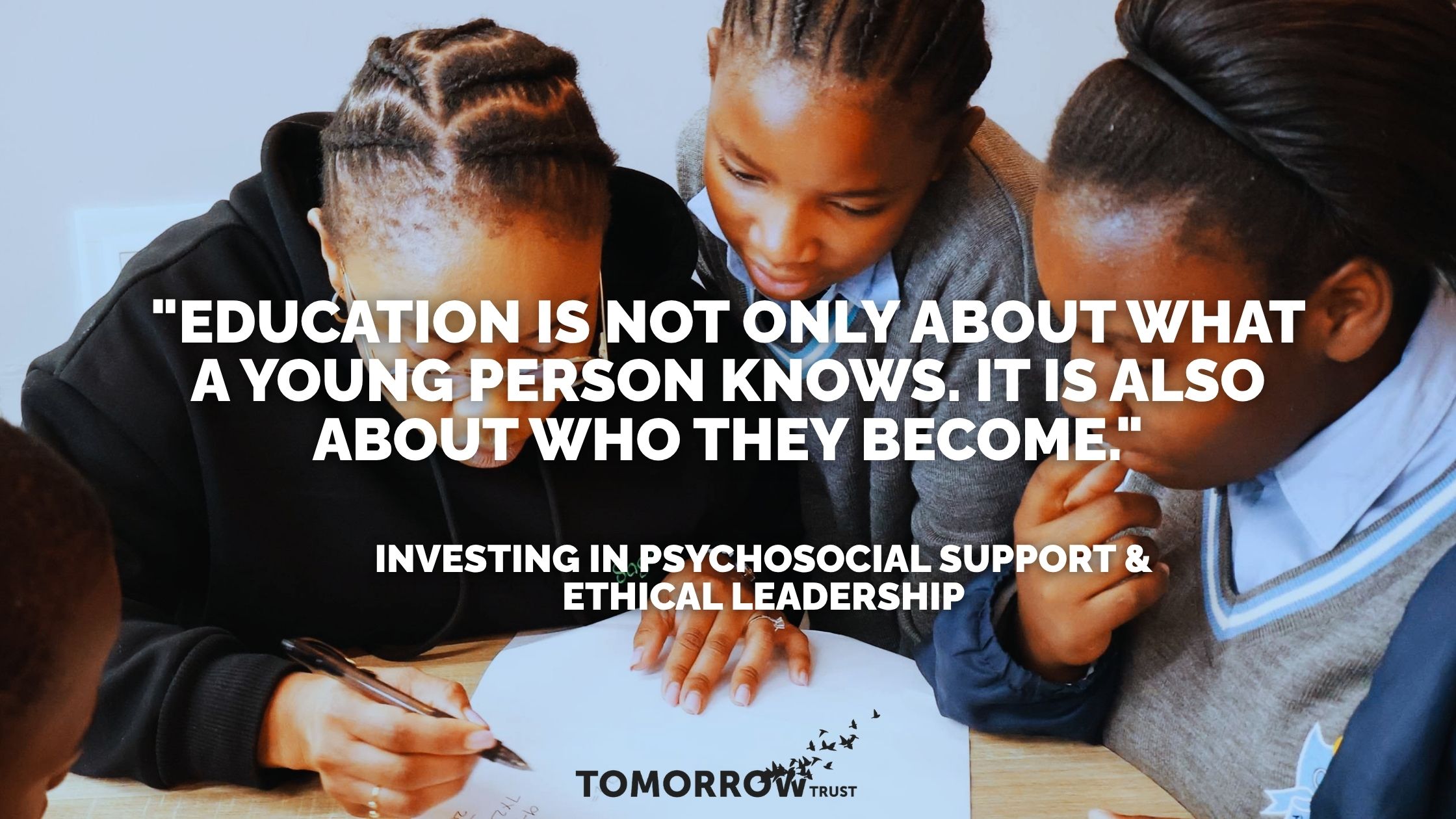
Because education is not only about what a young person knows. It is also about who they become.